







Is AI Better than Bacon?
Is artificial intelligence better than bacon? One crunches data, the other crunches joy. This playful, slightly unscientific showdown pits algorithms against cured pork and bacon still wins.

TL;DR AI can analyze data, automate work, and write blog posts about bacon, but bacon still wins because it delivers instant joy, sensory pleasure, and universal happiness without electricity, updates, or existential dread.
In one corner, we have artificial intelligence: the digital wizard that can calculate faster than a thousand mathematicians and compose music at the click of a button. In the other corner, we have bacon: the crispy, smoky breakfast legend that can send your senses into a joyous frenzy.
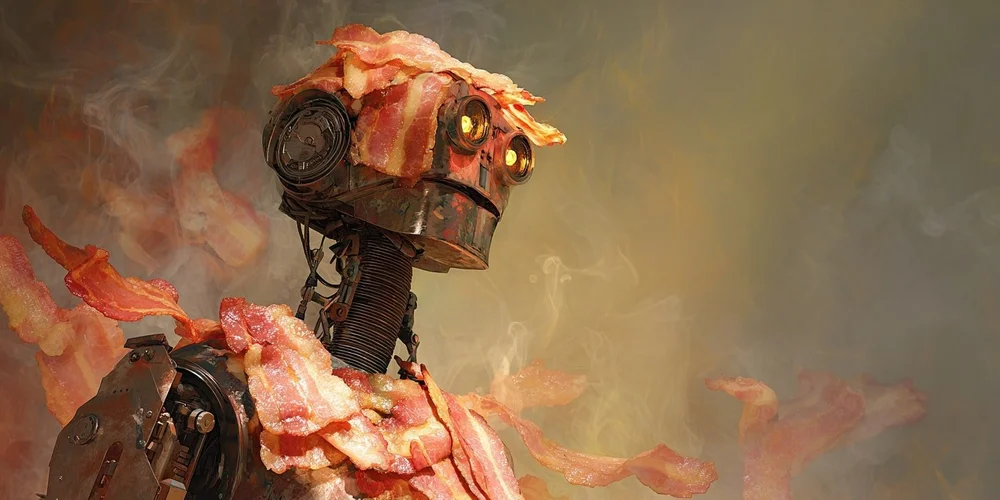
It’s a ridiculous question on the surface … comparing cold, calculated code to hot, sizzling strips of cured pork. But in the spirit of fun (and actual insight), let’s pit AI against bacon in a battle of wit, utility, and deliciousness. Grab a snack (might we suggest a bacon sandwich?) and enjoy this satirical showdown between silicon and smoked pork, where we are biased towards the point that bacon is the clear winner overall … except maybe in a few narrow (and totally unfair) contexts where AI catches up. Let the tongue-in-cheek comparisons begin!
Sensory Delight vs. Digital Might
“Mmm, I just love the smell of machine learning in the morning.”
Let’s start with the obvious: bacon engages the senses in ways no algorithm ever will. The sizzle in the pan, the aroma that fills the kitchen, that first savory bite … bacon is a full-on sensory experience. AI, for all its brilliance, has no sense of smell or taste. You can’t feed an AI a strip of bacon and watch it smile; at best, you’d see some blinking lights on a server. Bacon wins this round before AI even knows the game has started.
Consider a simple morning scenario: Walking into a house that smells of bacon will instantly make most humans drool, and their hearts flutter with joy. Walking into a house that “smells” of AI? There is no smell of AI … maybe a bit of warm electronics if anything. You’ll never hear someone say, “Mmm, I just love the smell of machine learning in the morning.” Meanwhile, bacon’s smoky perfume could probably be bottled and sold as cologne (in fact, it basically has … bacon air fresheners and bacon-scented candles are very real). AI might be able to identify the chemical compounds of bacon’s aroma or simulate it in a virtual environment, but it can’t truly experience it. And experiencing is where bacon shines.
To drive home the point, here are a few head-to-head sensory comparisons between AI and bacon:
Smell and Taste … AI can analyze the molecular makeup of bacon, but it can’t smell or taste a darn thing. Bacon, on the other hand, is smell and taste. It’s practically the universal smell of “Breakfast happiness.” Winner: Bacon, by a nose (and tongue).
Sound … bacon comes with its own theme music: that sizzle-pop-crackle in the frying pan is one of the most delightful sounds on Earth. AI’s sound? Maybe the gentle hum of a computer fan or a robot saying “beep boop.” Not exactly an eargasm. Winner: Bacon again, loud and clear.
Sight … okay, AI can technically generate stunning visuals and endless lines of code. But have you seen a plate of bacon and eggs? That sight can make a person’s day. (AI might generate a pretty image of bacon, sure, but it’s a tease … you can’t eat a JPEG.) The sheer visual appeal of bacon’s golden-brown strips far outweighs lines of code scrolling on a screen for most of us. Winner: Bacon, because you eat with your eyes first.
Touch … bacon is delightfully tangible … you can pick it up, feel its crispy (or chewy) texture, and yes, grease is a tactile experience (maybe a messy one, but still). AI is untouchable, literally … it is software. You can’t hug an algorithm. (Well, you can hug your laptop after a successful program run, but it’s not the same and might be a tad warm.) Winner: Bacon, hands down (though you might want a napkin afterward).
In the realm of sensory delight, bacon has an overwhelming lead. AI’s might is purely digital … impressive in logic, but lacking any flavor (pun absolutely intended). As one might say philosophically: AI cogitates, therefore it is; bacon sizzles, therefore it rules.
Pop Culture and Universal Appeal
Bacon isn’t just food … it’s a cultural icon and a meme all on its own. For years, we’ve heard the saying “Everything is better with bacon.” People have tested that mantra by putting bacon in or on literally everything: bacon-wrapped steaks, bacon-topped donuts, bacon-infused bourbon, even bacon ice cream. There was a full-blown bacon mania in the 2000s and 2010s, where bacon became a star of internet humor and gourmet experimentation. We saw novelty items like bacon lip balm, bacon soap, bacon-scented candles, bacon band-aids (yes, stick a “healing” strip of bacon on that paper cut!), and even a bacon alarm clock that wakes you up with the smell of cooking bacon. Bacon-themed festivals popped up; “International Bacon Day” became a thing (first Saturday of September … a day to celebrate and consume all things bacon with reckless abandon). There are bacon-of-the-month clubs and even dating apps for bacon lovers to find their sizzling soulmates. In other words, bacon has achieved legendary pop culture status.
Now, what about AI’s cultural status? Sure, AI is everywhere in conversation … it’s the buzzword du jour, powering your smartphone’s assistant, recommending your next binge-watch, and yes, even writing tongue-in-cheek blog posts like this one. But culturally, AI tends to evoke a mix of awe, geeky excitement, and a pinch of dystopian fear. We have movies about AI taking over the world, news articles about AI beating humans at chess and Go, and social media threads debating whether AI will steal jobs or become our new overlord. Impressive? Absolutely. Universally beloved and craved? Not exactly. You won’t find people unironically wearing “I ♥ AI” T-shirts in droves, and there’s no “International AI Day” where people throw parties to honor algorithms (okay, techies did declare an “AI Appreciation Day” on July 16, but it’s safe to say it’s not celebrated with the same enthusiasm as Bacon Day, which often involves actual costumes, cook-offs, and unbridled gluttony).
Bacon has crept into our language and idioms over centuries. We say “bring home the bacon” to mean earning a living … bacon symbolizes success and sustenance. If you save someone’s life or reputation, you “saved their bacon.” Bacon is basically shorthand for something valuable and satisfying. Can you think of a familiar saying involving AI? Not really, nobody says “bring home the artificial intelligence” after a day at work. The only phrases with “AI” are like: “AI takeover” or “AI revolution,” which sound either ominous or just technical, not cozy or endearing. Bacon is comfort food and comfort lingo; AI is cutting-edge but hasn’t worked its way into our hearts or our idioms quite like bacon has.
Let’s not forget memes and social media. Do a quick search for bacon memes, and you’ll find endless pages of people proclaiming their undying love for bacon in humorous ways. There’s the iconic “Praise the Lard” parody posters, or countless GIFs of Ron Swanson (from Parks and Recreation) devouring bacon and eggs with intense reverence. Bacon has been the punchline and the star of many a joke. AI, on the other hand, is often the butt of jokes (“I for one welcome our new AI overlords”) or featured in screenshots of funny ChatGPT conversations. We laugh at AI’s mistakes or marvel at its outputs, but we laugh with bacon. Bacon is in on the joke as the lovable, greasy scamp of foods.
In terms of universal appeal, bacon pretty much sells itself. It transcends cultural boundaries; aside from dietary or religious restrictions that some folks have (and even then, turkey bacon or vegan bacon exists … a testament to bacon’s cultural pull that even people who can’t eat pork are trying to imitate it), bacon is desired globally. AI’s appeal is more niche … fantastic for tech enthusiasts, entrepreneurs, and sci-fi fans, but your grandma might not care about the latest GPT model … whereas if you fry bacon in grandma’s kitchen, guess who’s suddenly very interested? Exactly.
Verdict in the cultural arena: Bacon is a superstar, worshipped in pop culture and beloved by the masses. AI is the brilliant engineer behind the scenes … respected, even feared at times, but not something people’s hearts yearn for in the same way. One is a legend, the other is a trend. Bacon’s been hot (literally and figuratively) for centuries; AI is a hot topic for now. Advantage: Bacon, by a country mile (or should we say by a country breakfast).
Abilities and Utility: What Have You Done for Me Lately?
Alright, let’s be somewhat fair and look at what AI and bacon actually do for us. Bacon’s purpose in life is straightforward and noble: be delicious and make people happy (okay, and to provide some protein and fat, if we’re being nutritional). AI’s purpose is more complex: to solve problems, automate tasks, and augment human capabilities. They each excel in their domain, but those domains are hilariously different.
Bacon’s strengths are clear:
Culinary magic: Throw bacon into almost any recipe and you instantly elevate it. From wrapping asparagus to crumbling it on salad to laying strips on a burger, bacon is a cheat code for flavor. It’s the ultimate sidekick in the kitchen, sometimes even stealing the show as the main ingredient (looking at you, bacon-wrapped everything).
Mood booster: Bad morning? Bacon. Hangover? Bacon. Need to bribe a friend to help you move? Bacon (and maybe also pizza, but throw bacon on it). There’s a reason bacon is often called meat candy … it sparks joy. AI might brighten your day with a funny cat video it recommends, but bacon brightens your day by literally satisfying one of your deepest, primal senses: taste.
Simplicity and reliability: Bacon doesn’t crash, it doesn’t need a software update or a Wi-Fi connection. Its “interface” is a frying pan, and trust me, it’s user-friendly. As long as you have heat and a decent pan, bacon performs flawlessly 99.9% of the time. The only “error message” you might get is smoke if you cook it too long, but even burnt bacon has some fans. Bacon is delightfully low-tech, and that’s part of its charm … it just works (and smells amazing doing it).
AI’s strengths (yes, it has a few) lie in a very different realm:
Superhuman speed and intelligence: Need to calculate a million numbers, find patterns in a dataset, or navigate a car through traffic? AI is your champ. It can process more information in a second than a human could in a year. Bacon, delicious as it is, cannot perform calculus. (If you throw bacon strips at a math problem, you’ll just have greasy math papers. Fun, but not effective.)
Automation and efficiency: AI doesn’t sleep, doesn’t get greasy fingers, and can work 24/7. It can control your smart home, sort your email, translate languages in real time, and drive a robot vacuum under your couch. Bacon’s version of automation is … well, it has none. It will just sit there until someone (maybe an AI-powered stove?) cooks it.
Creative output (in its own way): Believe it or not, AI can be creative … it can write stories, compose music, and paint pictures (albeit by learning from humans first). AI art and AI-written novels are a thing. Bacon’s creativity is more about inspiring humans to be creative with it (bacon-themed haikus, anyone?). Bacon itself won’t be writing symphonies, unless the grease splatters on sheet music in a pattern that Beethoven would envy. Advantage AI here: it can simulate creativity. (Though one could argue the countless bacon recipes and bacon fan fiction out there are indirectly bacon’s creative legacy!)
Okay, okay, here is the bacon-themed haiku you were just wondering about:
Sizzling dawn whispers
Crisp joy crackles in the pan
Breakfast smiles back first
AI outshines bacon in specific utilitarian tasks. If you need to debug code or predict the weather, a plate of bacon won’t be much help (except maybe as a morale booster while you do those tasks). AI can crunch data, control machinery, and even generate new ideas in seconds. Bacon cannot write code … it can’t even write; it’s too busy being delectable. On the flip side, AI cannot cook itself breakfast … it can tell your smart oven how to cook bacon perfectly, but it can’t savor that achievement. AI also can’t cure your hunger … it can order you food, but ultimately you need actual edible matter, possibly bacon, to fill your stomach.
Let’s also address the health and survival aspects: If you’re stranded on a desert island, would you rather have an AI or a lifetime supply of bacon? Unless that AI can magically fish and forage for you (maybe if it’s attached to a robot), you’d likely pick bacon. Bacon provides calories; AI consumes them (figuratively, in the form of electricity). Historically, bacon (and other preserved meats) helped humans survive long voyages and winters. AI is helping humanity solve big problems, yes, but if we’re talking basic survival or comfort, bacon’s got your back (and your belly).
However, in fairness, AI has been helping doctors detect diseases, driving cars (with mixed success; hopefully no one’s trying to grease the wheels with bacon fat), and even composing music to help people relax. Those are genuinely impressive feats that bacon can’t compete with directly. Bacon won’t drive you to work. If anything, too much of it might drive you to the doctor (cholesterol is a worthy adversary). AI won’t raise your blood pressure out of sheer salt content, but it might increase your anxiety when you read yet another headline about robots coming for your job. Pick your poison.
In terms of “usefulness”, we might give AI a polite golf clap for doing all the fancy hard stuff. But usefulness isn’t everything in life. Happiness is also a factor, and bacon is really useful at making people happy in the moment. AI can make you more productive, sure, but bacon can make you smile. And at the end of a long day, would you rather have a helpful spreadsheet generated by AI or a plate of crispy bacon? (If you chose the spreadsheet, we respectfully question your life choices.)
Let’s call this one a split decision: AI wins in productivity and problem-solving, but bacon wins in immediate satisfaction and comfort. One helps you make a living; the other makes living worth it. How’s that for different skill sets?
By the Numbers: Absurd (But Insightful) Metrics
“Numbers don’t lie, especially ridiculous ones.”
Time for some ridiculous comparisons and numbers! We’re going to crunch a few stats (some real-ish, some completely absurd) to see how AI and bacon stack up in quirky ways:
Candle Competition … believe it or not, bacon-scented candles are a hit. There are dozens of varieties on the market, because who wouldn’t want their living room to smell like a Sunday brunch 24/7? AI-themed candles … well, those aren’t exactly flying off the shelves. (“Eau de Algorithm” isn’t trending in the home fragrance world.) For every AI-scented candle (if you manage to find one that presumably smells like warm plastic or the abstract concept of logic), there are probably a hundred bacon-scented candles sold. The score in candle sales? Bacon’s cozy aroma: 100. AI’s hypothetical scent: maybe 1. It turns out people prefer the smell of frying bacon to the scent of, um, math. Shocking, we know.
Hashtag Popularity … on Instagram and Twitter, #bacon has been a perennial favorite among foodies, with millions of posts featuring juicy bacon burgers and brunch platters. Meanwhile, #AI is filled with tech diagrams, futuristic art, and robots. Both are popular in their own spheres, but which hashtag do you think gets more heart-eye emoji reactions? A photo of bacon roses (yes, folks make bouquets of bacon) is going to melt hearts (and clog them a little, but that’s another story) far more reliably than a post about an AI algorithm. In the social media love contest, bacon wins on pure mouth-watering visual appeal.
Holiday Headcount … International Bacon Day gatherings can number in the hundreds or thousands in various cities. People throwing bacon-themed parties, festivals, and even bacon eating contests. National AI Day (yes, it exists on July 16) might see a handful of meetups or online webinars attended by diligent tech enthusiasts. The enthusiasm gap is real: one holiday has people literally wearing bacon costumes and eating themselves silly, the other has people… maybe updating their LinkedIn about it. We’ll let you guess which is which.
Merchandise and Novelty Items … a quick inventory check: Bacon has inspired a staggering array of merchandise. Bacon T-shirts, hats, action figures (think plush toys shaped like smiling bacon strips), and countless novelty items (did we mention bacon-print leggings? Those exist). AI-inspired merchandise? Perhaps a t-shirt that says “I ♥ Machine Learning” or a robot figurine here and there. The average person is far more likely to own a goofy bacon-themed item than an AI-themed one. Because “smart home AI assistant” isn’t something you wear on your socks, but a pattern of little bacon strips? Fashionable and mouth-watering.
Idioms & Expressions Count: the English language has at least half a dozen common expressions that give bacon a shout-out (“bring home the bacon,” “save your bacon,” “chew the fat”). Okay, that last one’s about fat, but bacon’s fat primarily anyway. Number of common expressions honoring AI? Zero. In fact, when we talk about AI in everyday terms, we often use analogies like “the computer has a brain” or “the algorithm learned” … we still relate it to ourselves. Bacon, meanwhile, has a linguistic life of its own. This metric might be abstract, but it highlights how deeply bacon is woven into our lives compared to AI.
Happiness Index (Totally Unscientific) … if there were a device that measured the average human’s immediate joy upon encountering AI vs encountering bacon, we suspect the readout would be amusing. Picture a platter of perfectly cooked bacon placed in front of a random person … cue the sparkle in the eyes and perhaps a little joyful gasp. Now picture someone getting a high-five from an AI chatbot … cool, but not the same visceral reaction. By our absurd calculations, bacon probably causes a 300% greater spike in spontaneous happiness than an interaction with AI. (Unless you’re a particular kind of person whose ultimate joy is debugging code. But even programmers, we note, often snack on bacon while coding!)
These metrics might be silly, but they highlight a truth: bacon dominates in the realm of human affection and day-to-day trivial popularity, whereas AI is often admired for its capabilities but not necessarily adored for its presence. We don’t throw parades because some code executed correctly (although maybe we should, for the programmers’ sake), but we will throw a full-blown bacon festival just because bacon is excellent. Numbers don’t lie, especially ridiculous ones.
Philosophical Detour: Mind vs. Stomach (or, I Think, Therefore I Ham)
“Skynet goes live, gains consciousness, and its first act isn’t launching nukes but raiding all the grocery stores for bacon.”
Time to get philosophical, because why not? At the core of this cheeky question, “Is AI better than bacon?” lies a deeper inquiry: What do we value more, the power of the mind or the pleasures of the flesh (the delicious, smoked flesh of a pig in this case)? It’s a classic brain-vs-belly showdown, Socrates meets Epicurus, high logic meets hearty breakfast.
AI represents the pinnacle of human intellectual achievement … it’s all about the mind, reasoning, intelligence, the very things that historically were thought to separate humans from animals. Bacon, humble and beautiful, represents something very earthy and primal … the satisfaction of basic human appetite, a connection to our senses and survival instincts. So which one is more “important” to being human?
One could argue, in a whimsical way, that our ability to enjoy bacon is just as profoundly human as our ability to create AI. Think about it: an AI can beat a chess grandmaster, but it cannot enjoy a simple pleasure. The very experience of enjoyment, of savoring bacon’s taste, is uniquely tied to consciousness and biology. If one day an AI becomes truly sentient, how will we test its humanity? Forget the Turing test … maybe we give it a slice of bacon. If it goes “Mmm!” and does a happy dance, voila, it’s basically human! (And probably very confused about why it didn’t discover this bacon thing sooner).
There’s also the Maslow’s hierarchy of needs angle. Food is at the base of the pyramid … you need to satisfy hunger before you worry about self-actualization. Bacon neatly slots in there as a high-ranking officer of foods. AI, in contrast, is sort of a luxury at the top of the pyramid … it’s a product of a society that’s already met its basic needs and is looking to optimize and intellectualize. In a world where people are starving, AI isn’t a priority … food is. And if that food happens to be mouth-wateringly tasty, all the better. In a sense, bacon (as food and as pleasure) addresses a more fundamental human need than AI does. You can survive without AI; you literally cannot survive without food (and life would certainly be a bit drearier without tasty food).
Let’s also get absurdly metaphysical: Some philosophers and scientists have debated what the “meaning of life” is. Could it simply be the pursuit of happiness? If so, a case can be made that bacon contributes mightily to small, daily happiness in a way AI seldom does. A perfectly crispy piece of bacon can feel like a tiny, meaningful moment in your day. A little reminder that the world can be good and joyful. AI’s contributions to meaning are more abstract. It might help cure diseases in the future or solve grand problems, which is deeply meaningful on a societal scale. But on a personal, in-the-moment scale, a piece of bacon on Sunday morning might subjectively feel more “meaningful” to a person than an AI running in the background of their phone.
And what about free will and desire? Humans often worry that AI might one day outsmart us, maybe even develop desires of its own. If one of those desires turns out to be bacon, well, that’s a plot twist for the ages: Skynet goes live, gains consciousness, and its first act isn’t launching nukes but raiding all the grocery stores for bacon. (Honestly, we might be sort of okay with a benign AI overlord whose only demand is “give me all the bacon”. At least we’d understand its motivations perfectly.)
In the end, this philosophical rambling highlights that comparing AI and bacon is like comparing the mind and the body, the future and the present pleasure, the abstract and the tangible. It’s a fun exercise because it reminds us that no matter how advanced our technology gets, we’re still creatures who find immense joy in simple things, like crispy strips of bacon. Perhaps the true wisdom is balance: use AI to improve life, but always stop to smell (and eat) the bacon. As a wise person (me, just now) once said: “I think, therefore I ham.” In other words, our ability to both think and enjoy something like bacon is what makes us beautifully human.
Narrow Victories: Where AI Catches Up (Almost)
“When it’s time to celebrate life’s victories, even those handed to us by AI, we still turn to bacon.”
Now, we’ve been singing bacon’s praises to the heavens (with good reason), but in fairness, we should acknowledge a few specific areas where AI might claim a win or two … if only because bacon wasn’t even competing in those races. Think of these as the consolation prizes for our silicon friend:
Data Crunching & Knowledge … if the contest is “Who can memorize the entire Encyclopedia Britannica or calculate 10,000 decimal places of pi faster?”, AI wins before bacon even puts on its running shoes. Bacon has zero capacity for math or memory (unless we’re talking your memory of that great BLT you once had). In this very narrow sense, AI is “better” … it can outthink any human and certainly any breakfast food.
Endurance and Work Ethic … AI doesn’t get tired. It doesn’t need sleep, coffee breaks, or motivation. It’ll keep optimizing your playlists or monitoring server traffic all night long. Bacon… well, bacon will eventually expire if left out too long. And you can’t exactly have bacon working for you nonstop. At some point, there’s just an empty plate and a feeling of fullness. So yes, AI is the tireless worker; bacon is more like the reward after the work.
Making More Bacon … here’s a funny one: AI might actually help create better bacon. How so? Through smart farming and food science. AI systems can optimize how we raise crops and livestock, maybe even help develop convincing plant-based bacon alternatives (for those who swing that way). In other words, AI’s narrow victories often end up serving bacon to us in the long run! It’s like AI knows it can’t beat bacon, so it might as well join the effort to produce more of it.
Health and Dietary Advice … if you ask an AI nutritionist, it’ll probably tell you not to eat bacon every day. It can analyze your cholesterol levels and shake a virtual finger at you for reaching for that fourth strip. In terms of keeping you alive longer, AI might be better … it can remind you to take a walk, drink water, and maybe swap bacon for a salad once in a while. Bacon’s goal in life isn’t longevity (quite the opposite, if you indulge too much). So, from a strictly health-conscious perspective, AI could claim a win … albeit a very boring one. (Let’s be real, living to 120 eating kale might technically be a win, but wouldn’t you rather live to 100 and have had some bacon? That’s a personal call.)
Creating Content (About Bacon) … we have to concede, this very article is proof that AI can form coherent sentences and jokes … arguably a creative task. Could bacon write a blog post comparing itself to AI? Nope. (If it could, it would probably just write “Eat me” and that’s it.) So in the contest of literally producing an essay or art, AI wins … with the ironic twist that AI often loves to write about bacon because it has learned humans find bacon amusing and tasty. So even in AI’s victory, bacon is the muse.
These narrow contexts are interesting because they show that AI is incredible at what it’s designed for: computation, optimization, automation, but those things often don’t overlap with bacon’s domain of sensory joy and comfort. It’s like comparing a spaceship to a hot fudge sundae. The spaceship will get you to Mars, but the sundae makes a rainy afternoon on Earth a lot better.
So yes, hats off to AI for not needing a nap and for doing all our boring tasks. It’s definitely “better” than bacon at driving a car, managing your bank account, or diagnosing an illness. We’ll happily give AI that credit. Bacon wasn’t even trying to compete there. But (and this is a huge but), if an AI wins a Nobel Prize for saving the world, you can bet the celebration party will be serving bacon-wrapped appetizers. Because when it’s time to celebrate life’s victories … even those handed to us by AI … we still turn to bacon.
The Crispy Conclusion: And the Winner Is …
Drumroll, please… After a highly unscientific, wholly entertaining analysis, it’s time for the cheeky verdict. Is AI better than bacon?
Nope. Bacon wins. ????????
Sure, AI is amazing. It’s powerful, smart, and transforming the world in serious ways. But bacon is… well, bacon. It’s the gold standard of delight. It reigns supreme in kitchens and hearts, while AI hums away in the background, quietly doing its thing. Bacon doesn’t need a user manual or a degree in computer science to be appreciated. It just needs a hot pan and a hungry belly. AI might run the next revolution, but bacon won lunch and dinner a long time ago.
In our playful showdown, bacon takes the crown in the categories that truly matter to everyday folk: bringing joy, enticing the senses, and being a cultural icon we actually want to invite to parties. AI, for all its intellect, is like a competent but slightly awkward guest … you’re glad they’re around to help clean up, but bacon is the life of the party everyone came to see (and taste).
The final lesson here? Life is better with a bit of both: let AI handle the heavy lifting and mundane tasks, but let bacon handle the celebration and satisfaction. We can enjoy the marvels of technology and still unapologetically love the simple pleasure of a crispy strip of bacon. It’s not really a competition after all … it’s a balance. But if a tongue-in-cheek answer is required: Bacon is still the greater of two goods in the halls of human happiness.
So, in the tongue-in-cheek spirit of this piece: Long live our greasy, glorious champion bacon! ???? And to AI, a tip of the hat for trying. Maybe in a few more decades, when an AI can download itself into a robot that cooks and then eats bacon with us, it’ll truly understand what it’s up against. Until then, the Bacon > AI club has plenty of room, and its meetings include complimentary breakfast.
Cheeky verdict delivered. Now, if you’ll excuse us, all this writing has made us hungry… time to reward our brains with the real winner.